

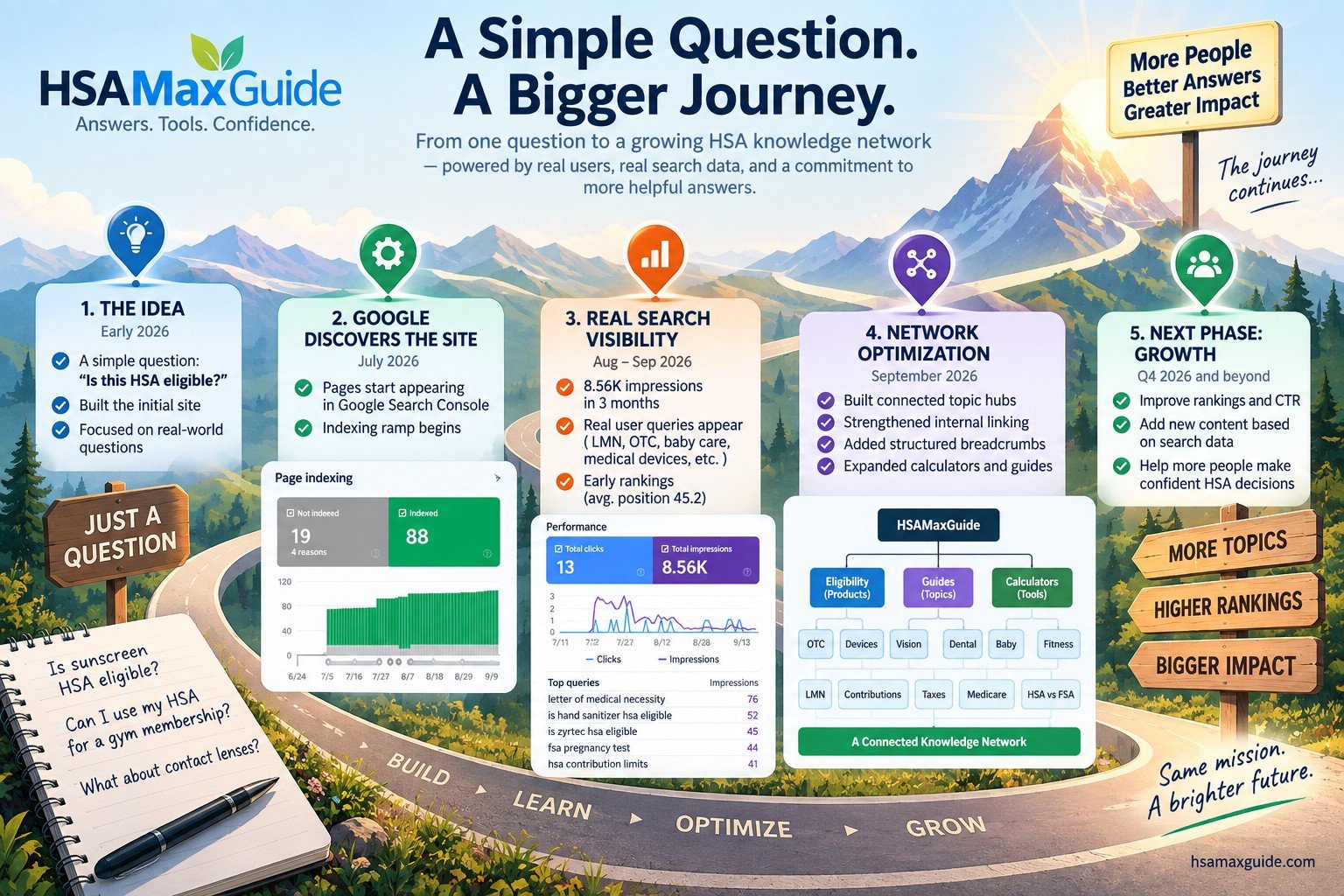
It started with a simple question.
“Is this HSA eligible?”
That was the basic idea behind HSAMaxGuide.
Not a giant financial website. Not an attempt to become another generic personal-finance blog. Just a useful destination where someone could ask a straightforward question about an HSA-eligible expense and get a straightforward answer.
Questions such as:
- Is sunscreen HSA eligible?
- Can I use my HSA for a gym membership?
- What about contact lenses?
But the more I built, the more interesting the project became.
Today, HSAMaxGuide is developing into a connected information system covering HSA/FSA eligibility, contributions, reimbursement, Letters of Medical Necessity, state tax treatment, calculators, and related guides.
And the most interesting part of building it hasn't been the individual pages.
It has been figuring out how all of those pages should work together.
The website started teaching me what it could become
One of the first lessons I learned from this project was that building a website and building a web of information are two different things.
It is relatively easy to create a homepage, a category page, a guide, a calculator, and dozens of individual pages.
The harder question is what happens when you have all of them.
Where should a reader go next?
How should a page about an OTC medication connect to a guide about eligible expenses?
How should a contribution calculator connect to an article about contribution limits?
How should a Letter of Medical Necessity guide connect to a question about gym memberships?
Those questions pushed me to rethink the architecture.
The goal became less about creating isolated pages and more about creating relationships between pages.
The first major lesson: search can tell you what to build
The next turning point came from looking at actual search data.
Instead of asking only:
“What pages do I think this website needs?”
I started asking:
“What is Google already associating with this website?”
Search Console began showing impressions around topics such as Letters of Medical Necessity, hand sanitizer, Zyrtec, Flonase, pregnancy tests, diapers, contribution limits, and medical devices.
Some of those queries weren't pages I had specifically set out to build around.
That was fascinating.
The search data suggested that Google was beginning to associate HSAMaxGuide with a broader set of HSA-related questions.
That changed how I thought about SEO.
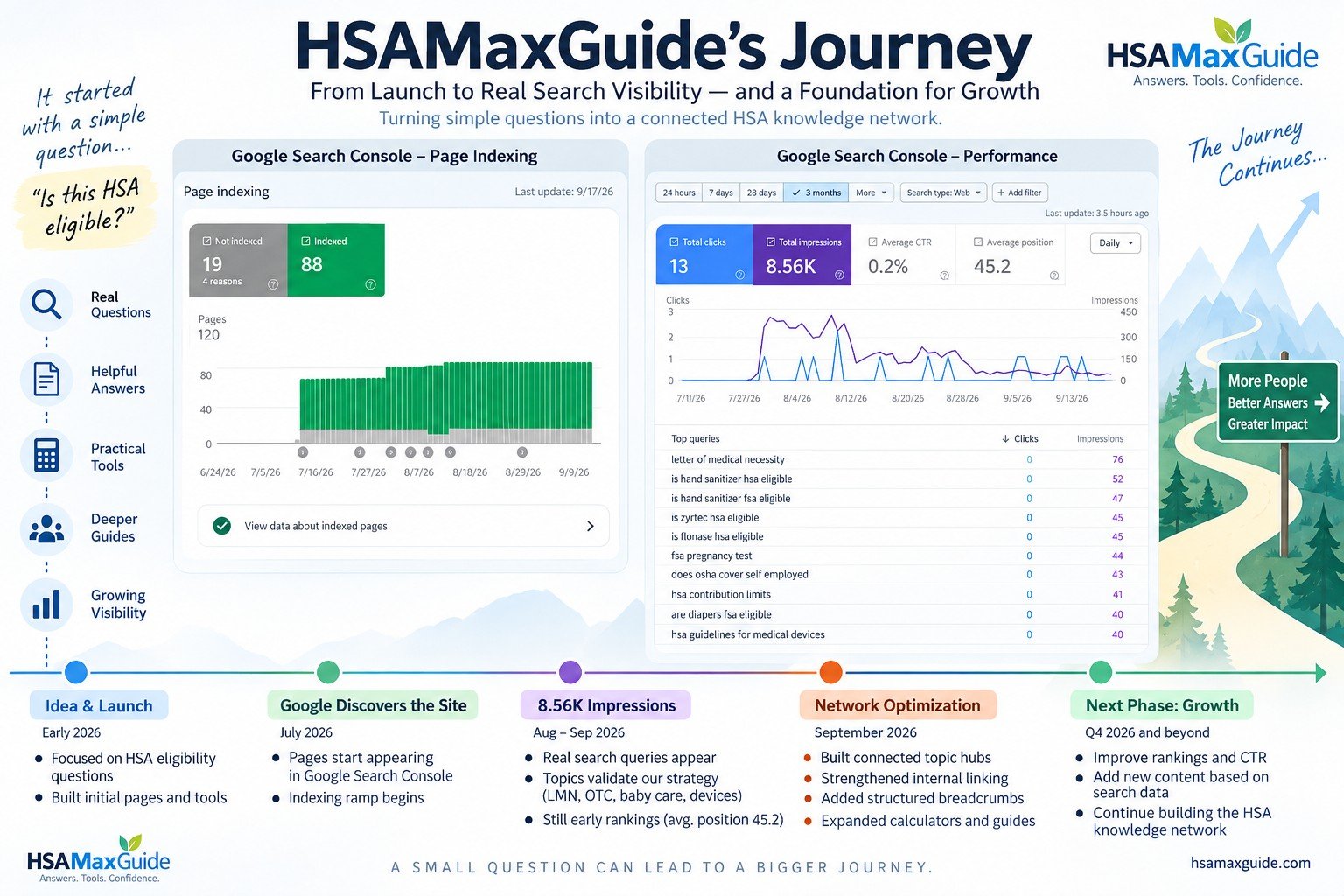
The data showed 8.56K impressions, 13 clicks, a 0.2% CTR, and an average position of 45.2 over the period shown. Those numbers did not mean the site had “made it.” They meant the site was beginning to generate real search evidence that could guide what came next.
The site didn't necessarily need more pages
This was probably the biggest realization.
My first instinct could have been simple:
“Google is showing searches for Zyrtec. Let's create a Zyrtec page.”
Then Flonase. Then Claritin. Then Allegra. Then another 50 products.
Before long, the site could have hundreds of pages.
But more URLs don't automatically create a better website.
So I started looking at the connections instead.
Suddenly, one page doesn't have to carry the entire topic.
The network carries it.
The Letter of Medical Necessity problem
Letters of Medical Necessity became another useful example.
The subject isn't really just one article. There are several questions hiding underneath it:
- What is an LMN?
- What might one need to contain?
- When might one be relevant?
- Can a gym membership qualify?
- What about fitness equipment or massage therapy?
- What documentation should someone keep?
That suggested a stronger architecture:
The important lesson wasn't that every question needs its own page.
It was that related questions need to have a place to connect.
Then I started seeing HSAMaxGuide as a network
The architecture began evolving into several major knowledge areas:
Eligibility
What can actually be purchased or reimbursed?
Contributions
How much can you contribute and what rules matter?
Reimbursement
How and when can you reimburse yourself?
Taxes
How can HSA treatment differ by state?
Medicare / Age 65+
What changes later in life?
HSA vs. FSA
How are the accounts different?
Tools
Can a calculator or checker help someone make a decision?
Guides
How can deeper explanations connect the individual questions?
These aren't really separate subjects.
They're different pieces of the same HSA ecosystem.
The calculator became part of the content
Another lesson was that tools shouldn't simply sit inside a /calculators/ directory waiting to be discovered.
A calculator can be the next logical step from an article.
The current HSAMaxGuide build includes calculators for HSA/FSA contributions and tax-related planning, HSA growth, and eligibility checking. The contribution calculator incorporates the 2026 limits used by the project.

The calculator isn't just a feature.
It becomes part of the information journey.
State taxes created another network
Then there was state taxation.
At first glance, this sounds like one article:
“Does my state tax my HSA?”
But that question immediately expands.
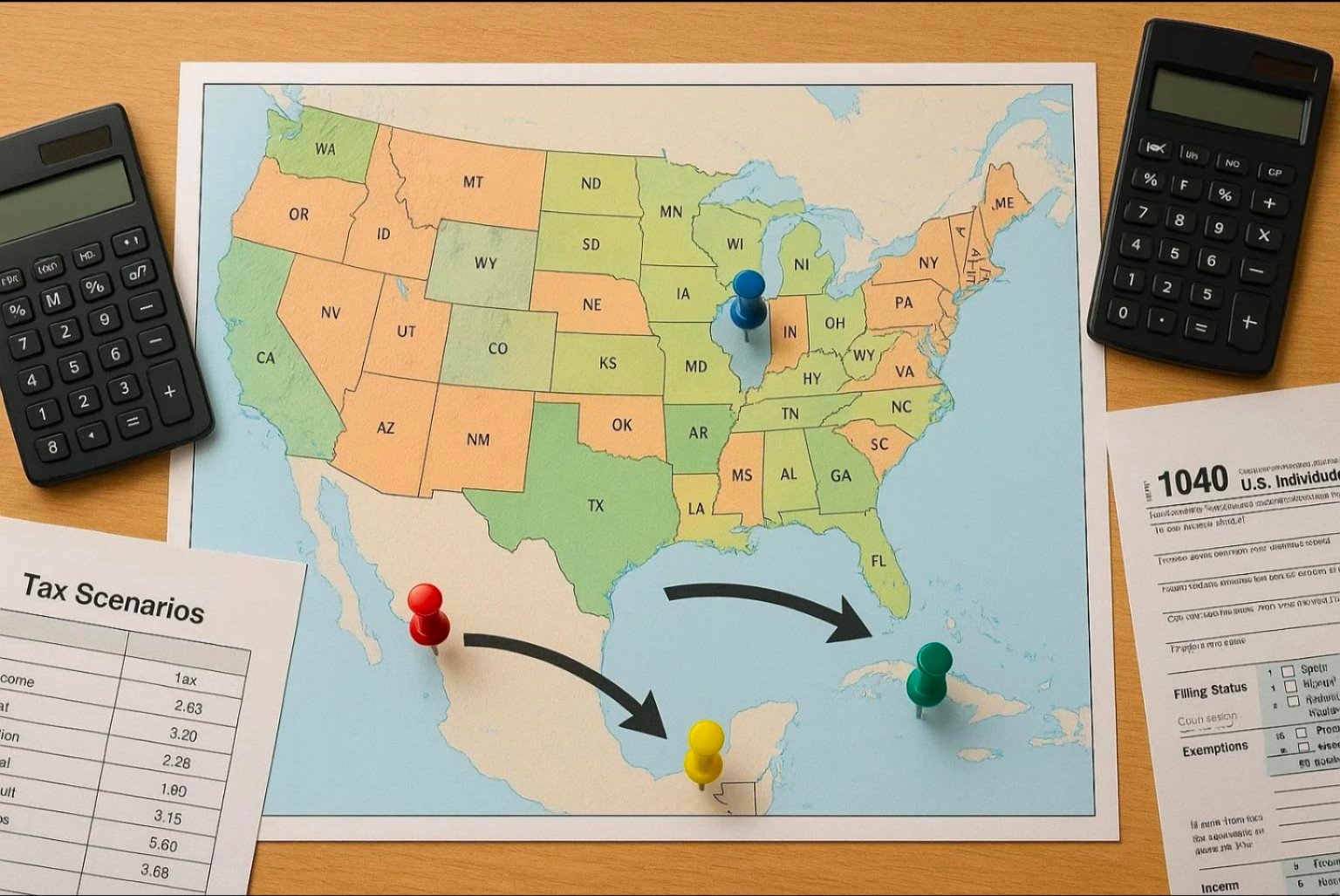
Someone in California needs a different explanation from someone in Texas. Someone in New York may need to understand the distinction between New York State and New York City. Someone in Illinois has a different state-tax context from someone in Minnesota.
That led to another architectural lesson:
A directory can become a gateway into a much deeper information network.
The state-tax section is now one of the clearest examples of how a seemingly narrow question can produce a structured group of related information.
HSA vs. FSA showed me something else
Some questions aren't really about eligibility.
They're about choice and understanding.
For example:
“What's the difference between an HSA and an FSA?”
That question touches ownership, eligibility, rollover rules, contribution limits, investing, employer sponsorship, portability, and reimbursement.
It isn't really a single comparison.
It's an entry point into a larger topic.
And that is another reason I increasingly think of HSAMaxGuide as a knowledge system rather than a blog.
The architecture changed
The original mental model was something like:
The newer model is closer to:
The objective isn't simply to make Google crawl more URLs.
It's to make the relationships between the URLs understandable.
And just as importantly, it should make the site more useful to an actual person.
The current challenge: making the network work harder
This is where the project is now.
HSAMaxGuide has enough content to establish several meaningful topical clusters. The next challenge isn't simply:
“What else can I publish?”
It's:
“How can I make what already exists work together better?”
That means strengthening:
- Internal links
- Topic hubs
- Contextual recommendations
- Breadcrumbs
- Calculator pathways
- Category relationships
- Guide relationships
- Search-driven content expansion
In other words:
Less isolated content. More connected content.
What I'm learning from building it
1. SEO isn't just keywords.
It's architecture, relationships, intent, evidence, and usefulness.
2. Search Console is more than reporting.
Search data can become a source of product and content ideas.
3. A website can be thought of as a graph.
Pages are nodes. Links are relationships. Topics are clusters. Tools are destinations.
4. More content isn't always the answer.
Sometimes the answer is better organization and stronger connections.
5. Building teaches differently than reading.
Real projects expose problems that tutorials and theory don't fully reveal.
6. The first architecture doesn't have to be the final architecture.
A site can evolve as evidence changes what you understand about the problem.
Why I'm documenting HSAMaxGuide
This project isn't just about HSAs.
It's part of a larger experiment I'm doing through GardySpace:
How much can I learn by actually building things?
A concept starts as an idea.
The idea becomes a website.
The website produces data.
The data reveals problems.
The problems force architectural decisions.
Those decisions create another round of learning.
And the cycle continues.
That's the part of digital building that interests me most.
Not simply launching something.
Building it. Watching it. Questioning it. Rebuilding it.
The question changed
HSAMaxGuide started with a question:
“Is this HSA eligible?”
But building the site gave me a different question:
“What happens when I build around the questions people are actually asking?”
That's what I'm exploring through HSAMaxGuide.
Not just how to publish more pages.
Not just how to get more search traffic.
But how a collection of information can become a useful system.
And that's increasingly what GardySpace is about.
Observe what happens.
Learn from it.
Rebuild it.
Then do it again.
What's next for HSAMaxGuide?
The next phase isn't about creating a mountain of new pages.
It's about optimizing the network.
The goal is for someone to enter HSAMaxGuide through almost any question and naturally find their way toward:
That's when a collection of web pages starts becoming something more.
It becomes a knowledge network.
And that's the journey I'm documenting here.
Explore the project
Explore HSAMaxGuide and see the system in action.
Explore the GardySpace Blog for more build-in-public stories, project analysis, and lessons from building digital products.
This journal entry documents the build and evolution. View the complete HSAMaxGuide project →